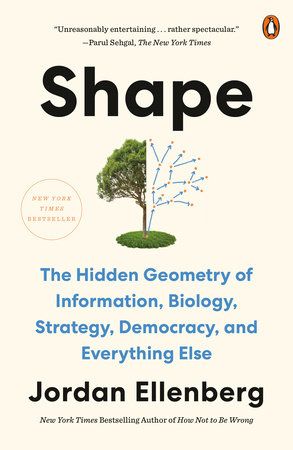
 by Jordan Ellenberg
I always feel mixed about reading popular surveys of a topic. They're never as exciting as reading something more targeted and idiosyncratic. It's a lot like listening to a greatest hits album - you sort of miss the rhythm and groundedness of living with an album or targeted investigation.
But it does give you a big picture that can help orient and bridge future reading. This book helped me connect graphs (of topics, of ideas) to the origins of geometry - and to think about how it's built on spatial intuition that we abstract out of the physical world. That is fun to think about in terms of how to represent knowledge in a spatial interface.
I also found the examples of how you can use randomness to explore a space - building up an understanding of the probability space. I connect this to procedural generation. It's fun to think of randomness as a tool, and to get a better since of the shape of it - what it can do for you within a system. One of the specific examples related is how to use randomness in graph splitting to generate a bunch of possible voting districts - comparing calculated results for the random versus the gerrymanded is the best way to 'prove' a gerrymander and get an idea of the benefits its giving (versus the mean).
I really liked the ending, which featured two poems about learning math by Rita Dove. I liked that those poems connected the experience of learning math with the physical details around them - plants and rain outside. The Geometry poem imagines the house transforming and splitting open as a proof is understood. That reminded me of some meditation exercises where you try and open up your head to the sky. I like the connections between understanding and how it feels, in that moment, in your head.