Feed

Internal Complexity

I'm loving some of the descriptions of internal complexity in How Buildings Learn, like this one from Brian Eno:
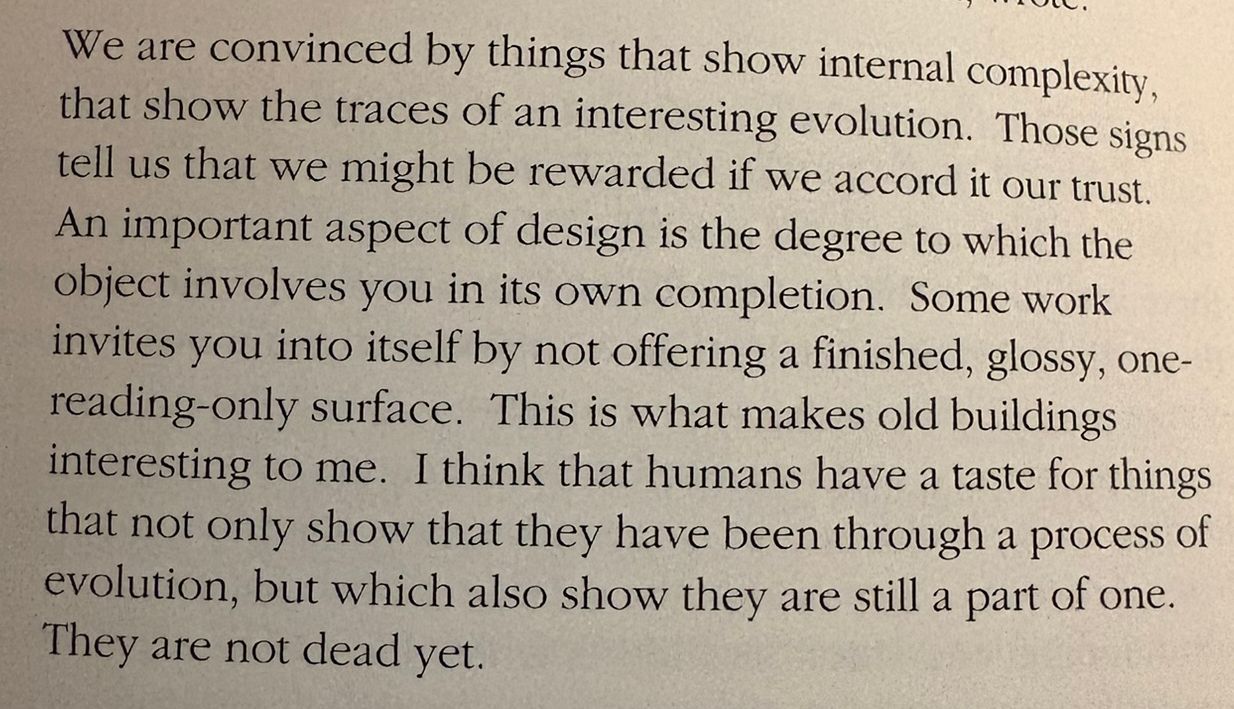
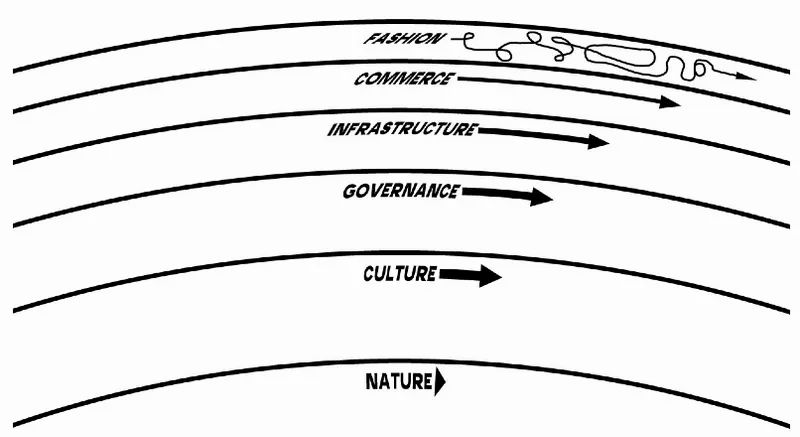
That complexity builds out of shearing layers. It's a result of different timescales at work.
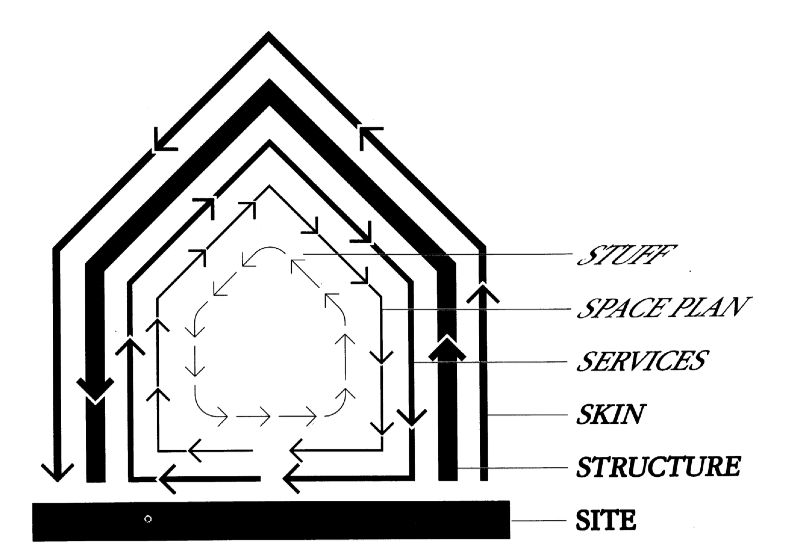
Shearing layers in a buildingShearing layers in a building

Civilizational shearing layersCivilizational shearing layers

So partly it's about the moves you make within constraints. But it's actually a gradient of constraints. If you really want to move the wall in a building, you can, but it may be more or less difficult depending on the wall and the building. Maybe instead of moving the wall you'd like to move you make your pantry shelves in an area a little separated from the kitchen. Maybe you find some other small opportunity within that process that provides more character (a place to display all your novelty mugs... or something).

What the Eno quote gets at is that going into someone else's space, you can recover some of those decisions and responses. You can reconstruct the story of the space. And as you're doing that, you're extrapolating and remembering your own experiences.

And part of it has to also be that you're recognizing patterns of evolution from nature. where you have different organisms growing at different speeds and responding to each other in these complex feedback loops.

So the object you're looking at is not just the object. It's also to different degrees a story of its evolution. And it's interesting to try and figure out how we recognize that story, what recognizing that story does for us.

Of course, with all this, I'm thinking about software and AI. I think Eno's description of internal complexity can be a description of what's missing in generated media or programs. I don't think that's the end of the story though. I think there's probably routes where we can use the technology and build back in different kinds of productive constraints. To be written about another day.
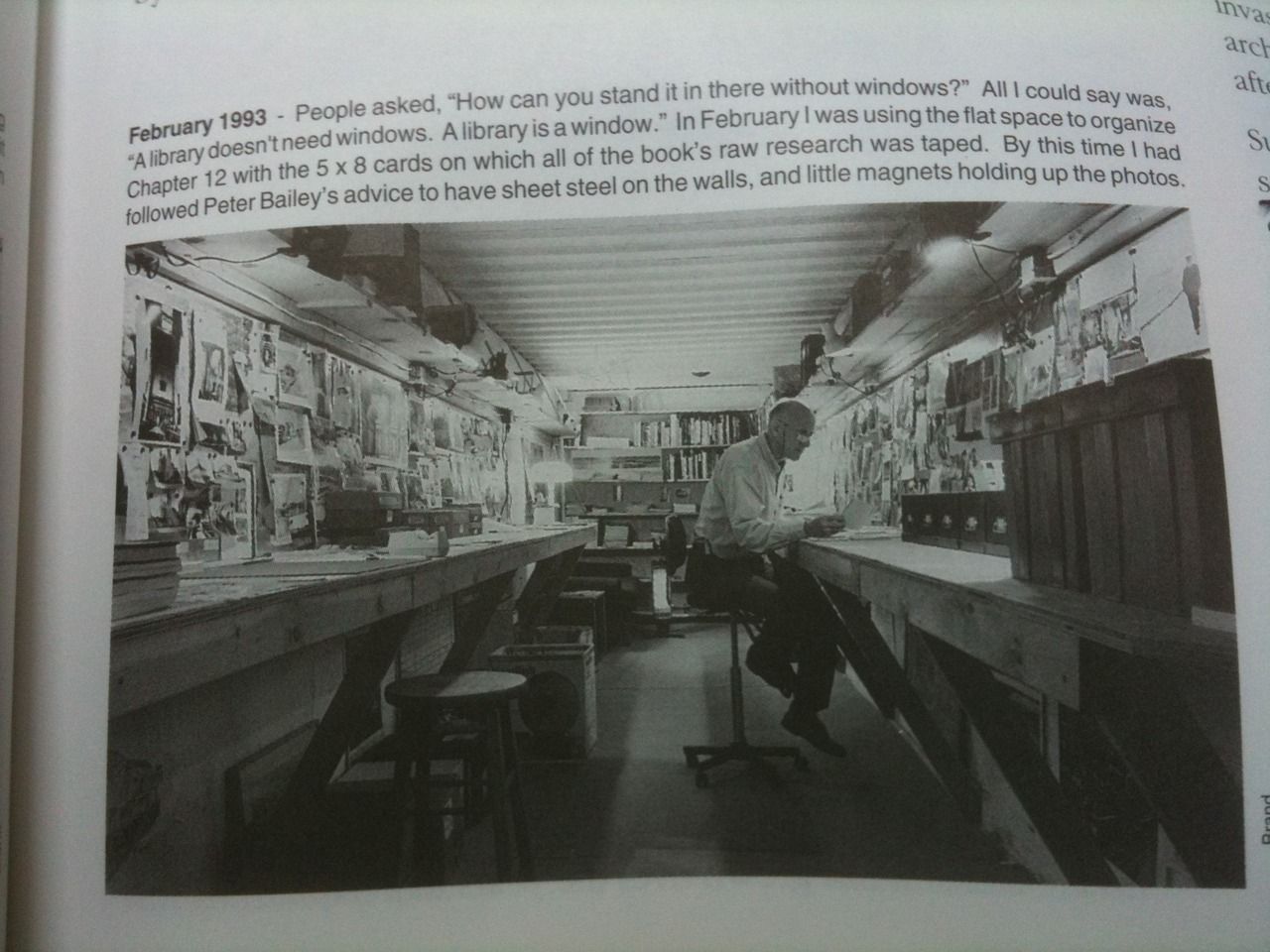
Stewart Brand's shipping container workspace

Stewart Brand in his shipping containerStewart Brand in his shipping container
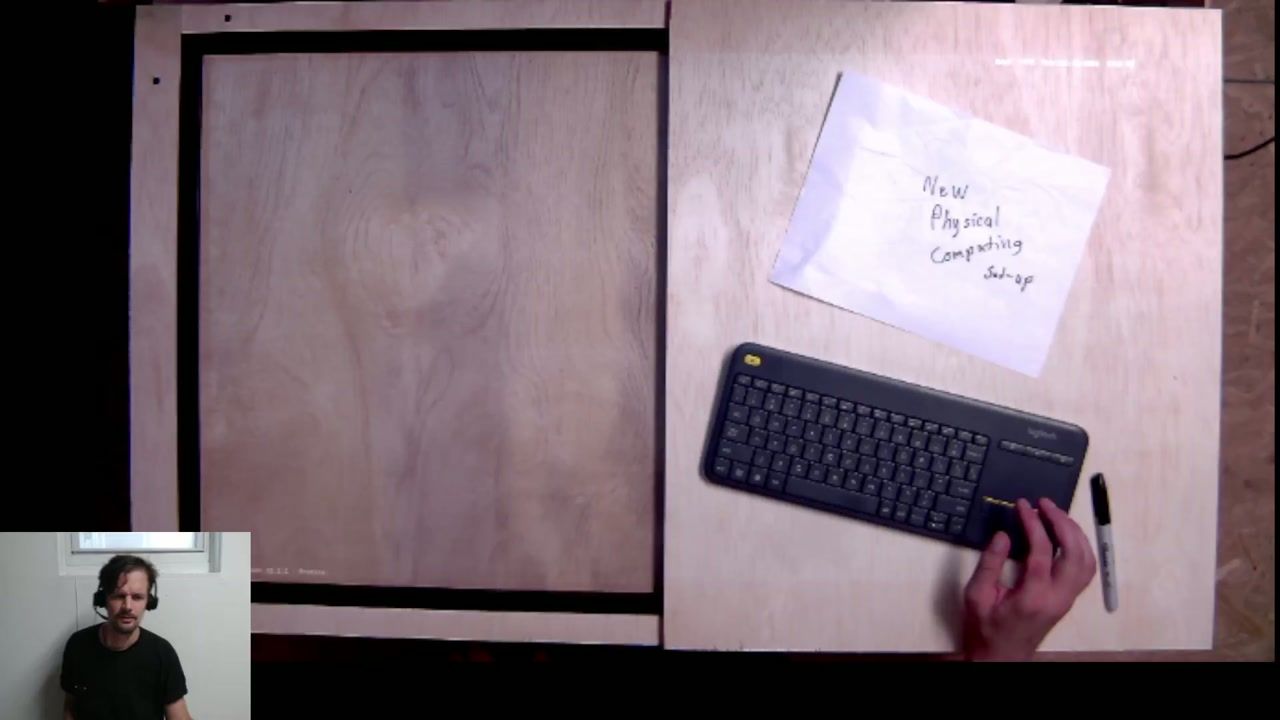
Working on the digital tabletop got me thinking back to Stewart Brand talking about how he constructed How Buildings Learn:

...the most important tool for organizing projects is lots of horizontal space and immediate-to-hand storage…

To that end he uses a shipping container with steel sheets to pin photos to and "raw plywood work surfaces and shelves. It was heaven".

Reading this I immediately felt the pull of that kind of space, and continue to want to explore what a digital version of it could be.

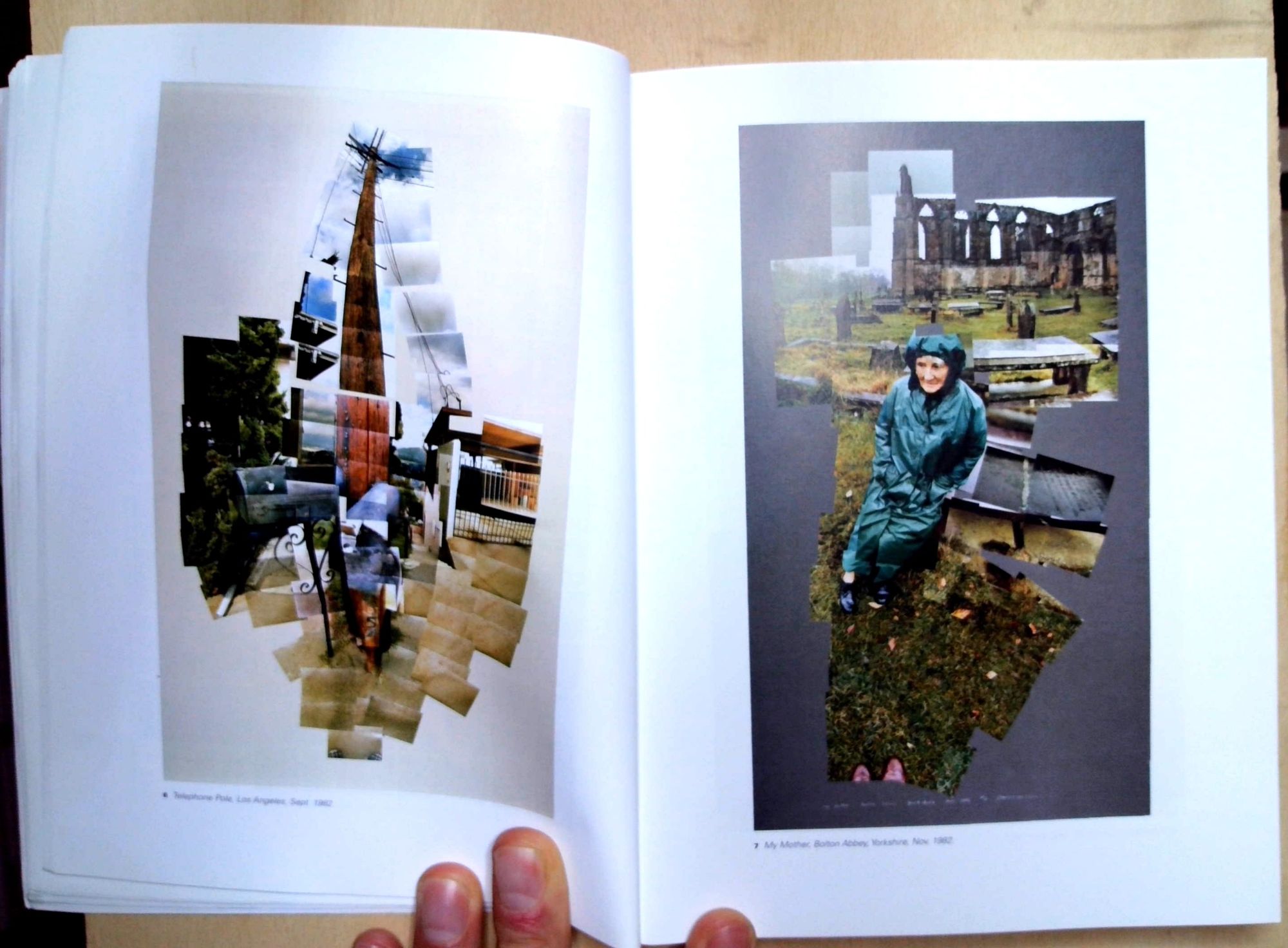
I think you can feel this approach in How Buildings Learn where there's a lot more attention to how photos are arranged on pages. Not in a "design-y" way but a sort of dense, hand-made way. In that it also benefits from being designed for a certain page-size (no responsive reflows to worry about).

Sources

My copy was lost in a "dog peed on the lowest shelf of the bookshelf" incident, so these quotes are from Austin Kleon's post, which includes a bonus reference to Hockney's art wall.

True to Life

by Lawrence Weschlerby Lawrence Weschler

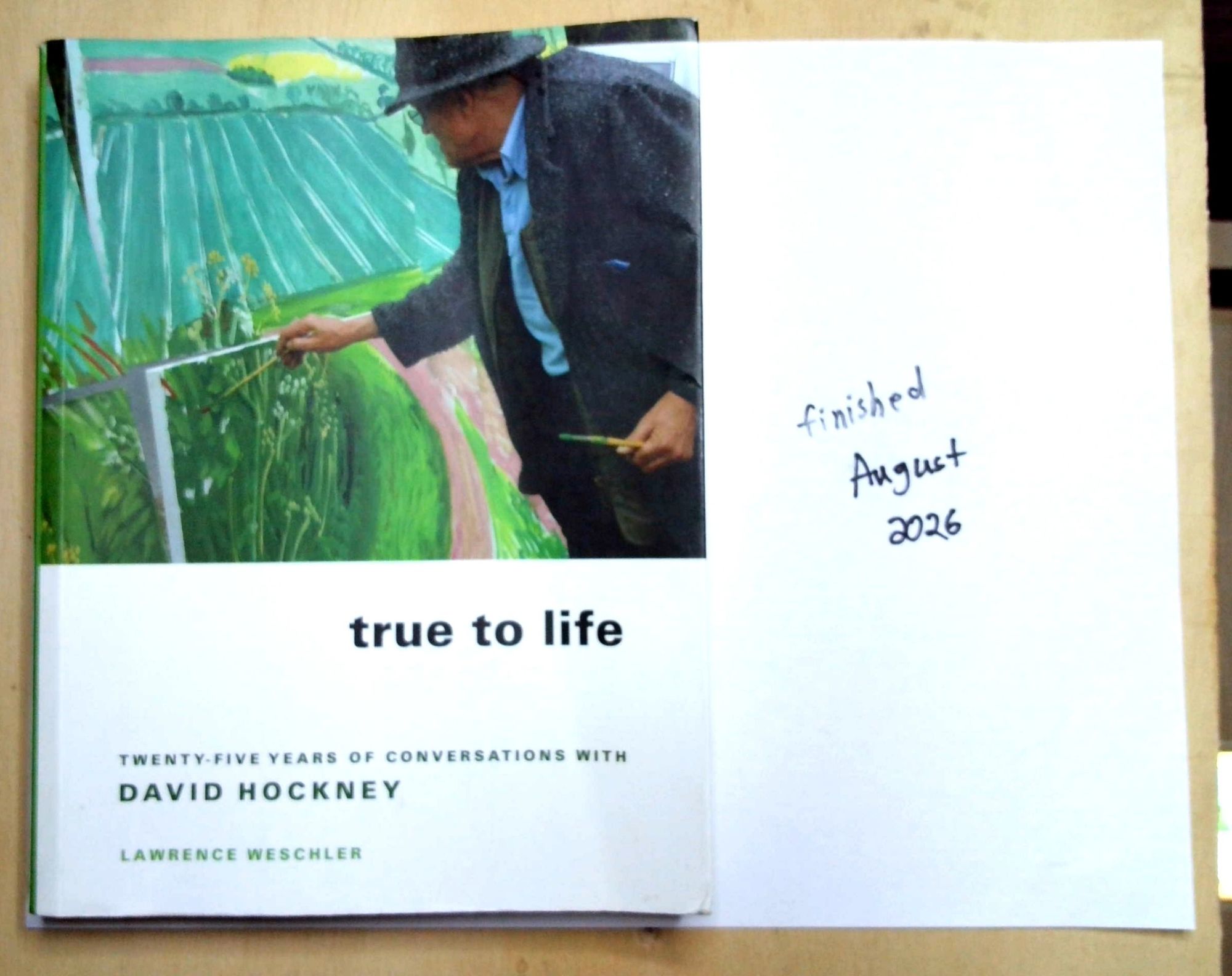
Cristóbal recommended this when I was working on my image sampler project. I read and loved the chapters on Hockney's camera works and then at some point set it down. In the meantime I read Weschler's Robert Irwin book and have never really stopped thinking about it. I got a paper copy and went through the whole thing.

Hockney's photo collagesHockney's photo collages

Ways of working

The first thing that struck me in the camera essays is how engaged Hockney is. Weschler is always visiting his house and to find him absorbed at his work table, full of new ideas of things he wants to try out. It made me think "I want a working life like that". Not necessarily on the same stuff, but with that same degree of interest. It definitely had an influence on my setting up my work table.

I thought the same thing through a lot of the Irwin book. How great is it that Irwin just goes off and reads phenomenology for a couple of years? Just because he thought it was important to his work and he trusted his own sense of what was important.

Representing space

Irwin is interested in how we perceive a space, and what sorts of interventions can be made to make us perceive a space more. Hockney is interested in how you represent an experience of space in 2D. In Hockney's ideas on perspective I thought a lot about projection, including projecting down to 2D from a multi-dimensional space (like embeddings).

I enjoy both their ideas and arguments there, but again my main takeaway is what a great way to be oriented towards the world. Hockney is always looking at the great paintings of history and new tech like photocopiers with the same attitude of "what can I learn from this", "what can I do with this".

Optics

I think I probably paused my first-read when I got into the section where Hockney tries to prove that renaissance painters used lenses and projections to trace subjects. Not that the idea or how he investigates it isn't interesting, but it is kind of a long digression from the other subjects I found more interesting.

Trees

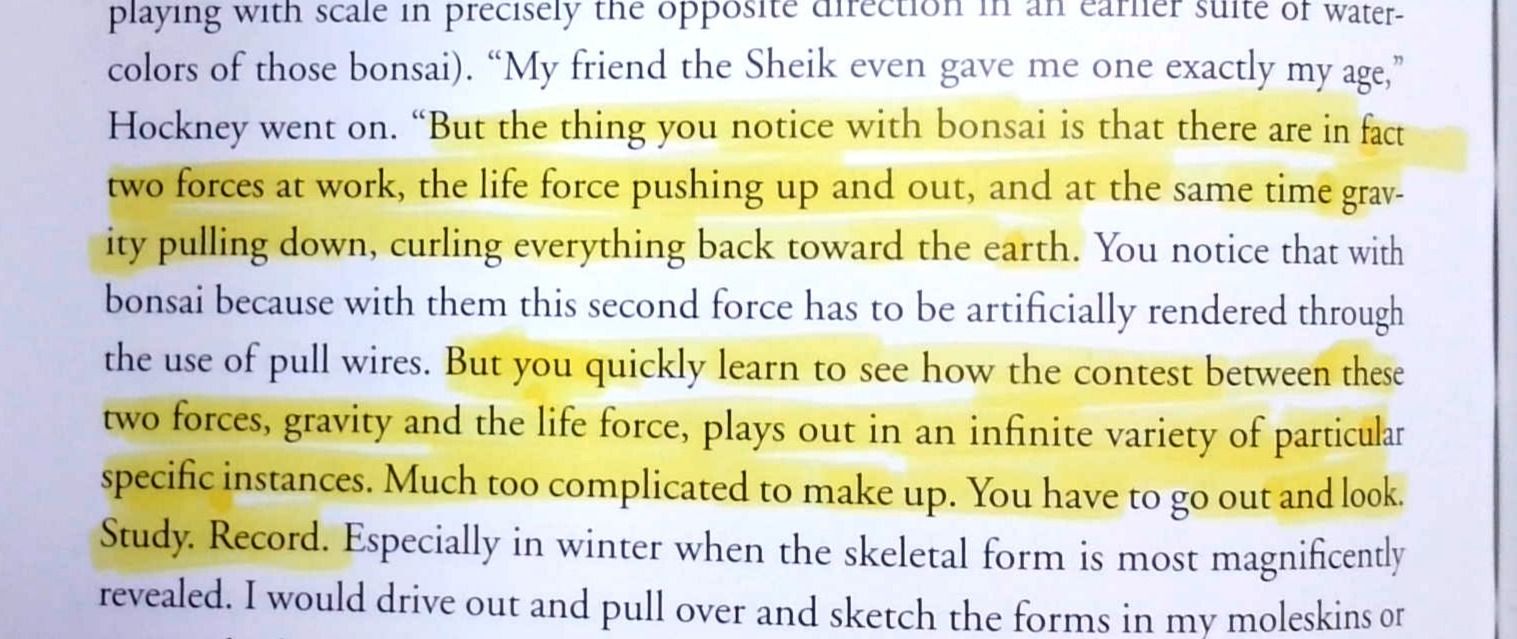
I enjoyed the last sections where he'd returned to painting. Particularly these thoughts on seeing and capturing trees.

Page 201Page 201

Page 202Page 202

Software physics

I like Andy Matuschak's use of the word "physics" to describe a set of rules in software tn his talk on the possibilities LLMs open up for programming. Two examples:

CodeMirror defines a rough physics of the medium: basic models for text, state, and selection, with transactional updates.

So, by way of generalizing from CodeMirror: could we define a physics of reading environments—one which could simultaneously support all these disparate augmented reading ideas, plus untold more yet to be invented?

You could also talk about those elements as constraints or primitives, but I like that "physics" suggests specifically the set of parts and mechanisms that make it function. The set of things essential to it doing whatever it is it does.

Stability

With the flexibility opened up by LLM code generation I've been thinking about ways to ground things.

Software that changes shapes and features all the time (even if in response to your requests) can be disruptive. Being completely unconstrained can be overwhelming.

Maybe there's inspiration we can take from the physical world, where building can also be pretty open-ended, to help build systems that are flexible but grounded. Forces described by physics: gravity, friction, constrain what can be built. They also describe the mechanisms by which those things operate. They limit and enable.

You can learn about the forces and then reason about them. You can think through machines in your head and then build and adjust. You can develop intuition about them.

The shared reality of physics means you can learn new techniques from looking at other machines (depending on how much of their functionality is exposed).

Digital physics

Maybe we can take lessons from the role physics plays in the physical world and apply them to the digital world. This could be by making our interfaces more tactile and tied to real-world manipulation. This is what I've been exploring lately.

I've also always been curious if we could promote the "physics" of how a computer works at a lower level. I think there are concepts, like caching and mapping memory, that do influence how programs are structured and could be interesting to foreground. But computers being designed to be general-purpose machines does make this kind of an uphill battle.

Either way, I'm enjoying framing the problem as what sort of "physics" to set up . What kind of physics could support adaptable programs and also give users a solid footing in using and evolving those programs?

Art as compression

David Hockney talking about the difference between photography and painting:

...the reason you can’t look at a photograph for a long time is because there’s virtually no time in it - the imbalance between the two experiences, the first and second lookings, is too extreme.

I think you could poke holes in this, but I like the model:

  • The work of art is imbued with the energy of the artist looking
  • The viewer can unlock that energy by looking carefully at the work

The artist compresses their perception of the moment and the scene, then the viewer opens it back up. The unfolding does not fully recover the artist's experience -- and that's even better. The viewer interpolates in their own experience to the shape provided.

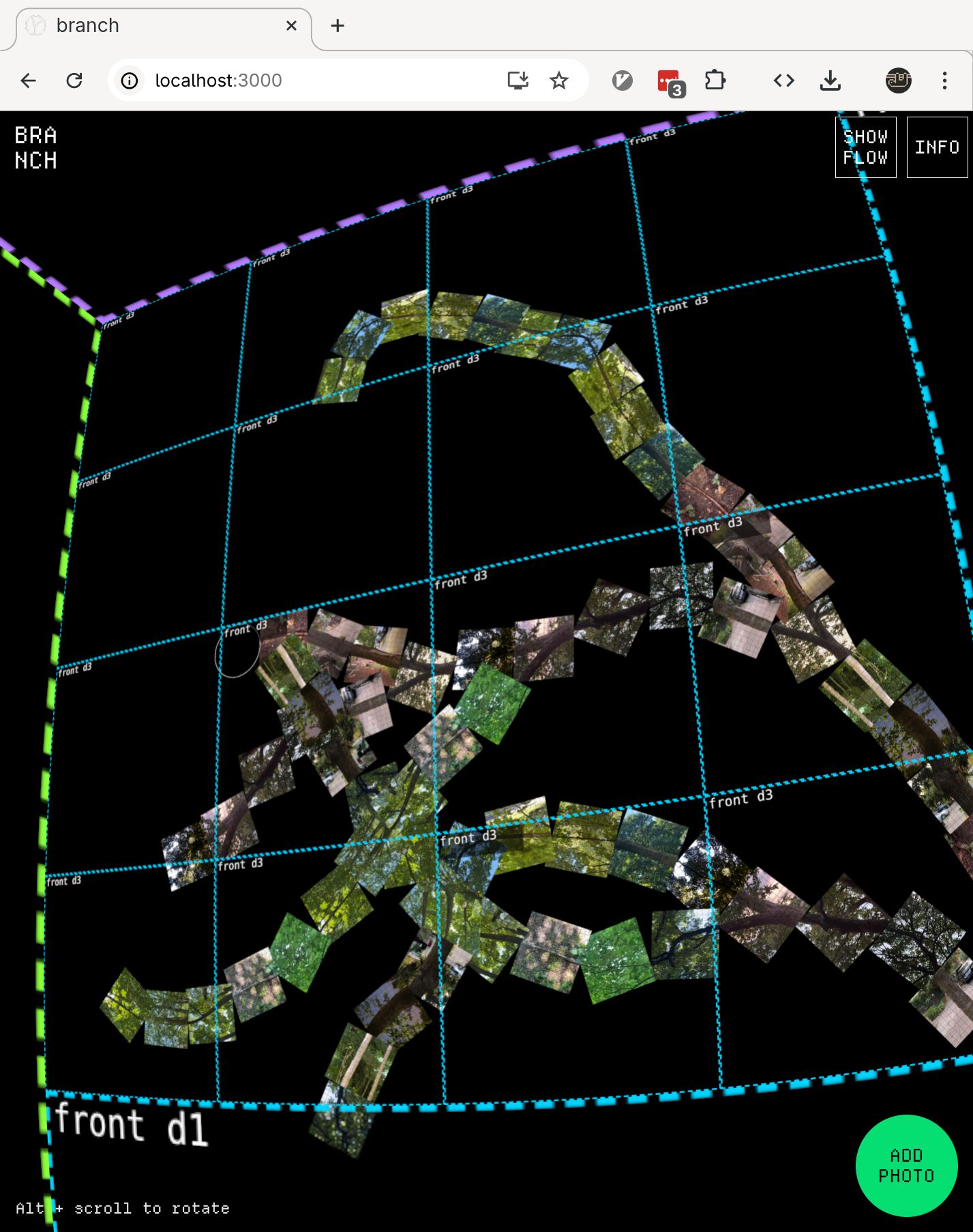
Branch

New on Constraint Systems:

Branch - a collaborative collage of tree and branch photos. Take a photo and trace the flow to add to a branch.

Exploring a few things, including:

  • multiplayer by default
  • images are tiled and additive so it should be able to scale forever
  • human draws the flow, algorithm connects them, light LLM-based content gate
  • trying to look closely at trees more

Take it for a walk (works nicely as a PWA):

The Stone Sky

by N.K. Jemisinby N.K. Jemisin

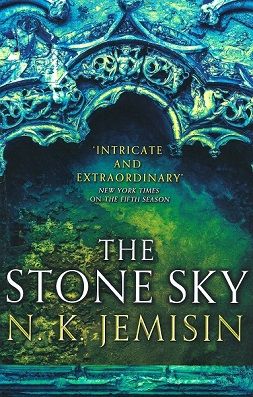
I moved a little slower through this one, mostly because I found a lot of the Nassun chapters tough (not in a bad way, just in an "I'm nervous for her" way).

There was a lot of lore to get through and resolve since it's the conclusion. Sometimes it felt like it was speeding through things, but by the end I was really happy with the full picture. Most of my questions were answered. it's still very small slices/vignettes from a much larger history. There's a world where I would have been interested to read more chapters from more perspectives, including more slice-of-life stuff, but that's also a different book.

I don't think I have a comprehensive understanding of the stone-eaters' story, which is probably the biggest lore introduced in this one. But the big resonant thing is that Hoa starts as this mysterious figure, extremely powerful and sort of inscrutable, and then his past is revealed as similar to Essun's and Nassun's - put into a situation they don't understand and that they try to change for the better with unintended consequences. It makes him empathetic and accepting of other people's mistakes, while also still attempting a plan to change things because what else is there to do (give in to despair and guilt, I guess). It humanizes him and the other stone eaters which was an interesting direction to take them. Near immortality and still flawed and with plenty of regrets.

Despite it being hard for me to read at times I ended up really liking Nassun's arc as well. I like Hoa's aside where he says (iirc) don't judge her actions so much because they are down to her circumstances, but look at how she can love so fiercely, and who did she learn that from. That's that thread that runs all the way through from the first book: an unflinching look at the pain caused by your actions but also empathy and understanding and acceptance of them.

The lore and mechanics of the society and the Earth's role in fighting back - I would say I didn't object to any of that, but it wasn't that feeling of "oh I love how this is fitting together". I still really enjoyed the texture of things and lots of the little touches.

Great series. Probably my favorite fantasy in terms of combining interesting texture and world ideas with characters that I care about and think about regularly. Maybe I'll read it again in another 5-10 years.

Blog rework and composition

Today I started in on blog revamp. Partly because I wanted to experiment with Matt Pocock's LLM skill workflow in a relatively conventional app (not a weird Constraint Systems experiment). Also because I've been feeling the edges of my current setup. Overall I'm thinking about how I want my software and computer to work in a world where LLMs make adding features/cheap.

Surface area

In the wave of LLM-assisted demos I think a lot about surface area. Adding features adds surface area. Particularly when the features are just kind of additional nice-to-haves. It can feel different if the features grow out of the center of the idea. That's like a tree growing out of a core. A bunch of ad-hoc features is a loosely connected collection of graphs, floating and tangling up into eachother.

It makes me want to make dense little slices of things - where the rules are constant all the way through. Things that mirror physical objects/toys where the rules are self-evident and the mechanisms visible.

This blog

This blog had bloated even before the coding assistants got really good. I edit it in a split view with a live preview, which is something I always wanted in a blog but now that I have it still feels a little sprawly. Lately I've been wanting to be able to edit blog posts in all kinds of places - separate little offline apps maybe - with one-click deploy. All doable! but requiring some thought.

Even more than the editor I don't like my logged-in experience. I set it so edit and add and special share buttons get added only for the logged-in view, and it always bugs me that I'm then looking at something different from what everyone else sees.

And lastly there's the kind of integrations. A key point of my early feed was automatic posts to twitter. I set up bluesky posts here but often rewrite them manually instead. I want to do a standard site atproto thing as well. All doable! But just thinking about them I shy away from the feeling of them being intertwined and annoying to iterate on or cut out (even if it's likely an agent that will do it).

Composition and cartridges

Another physical thing I think about often is game cartridges. The satisfaction and clarity of something being available when it's plugged in and totally gone if it's not. I'd love to do "automatic post to bluesky" and even "embedding search" as cartridges I can move in and out. Is this just plugins? Maybe. But I think there's something to the framing that's especially interesting to me.

Steps

So far I've got a rewritten blog rerendering in tanstack start. It's fast! Next I want to get styling in and then I'm going to think about what I want to do for an editor - maybe it will be an entirely separate app - maybe an electron-based app experience? Focused on calmer writing? And maybe there's opportunities to explore the plugin architecture (which is probably just an API) there. Or maybe I'll put it all back on the shelf. We'll see!

Constraint Browsers

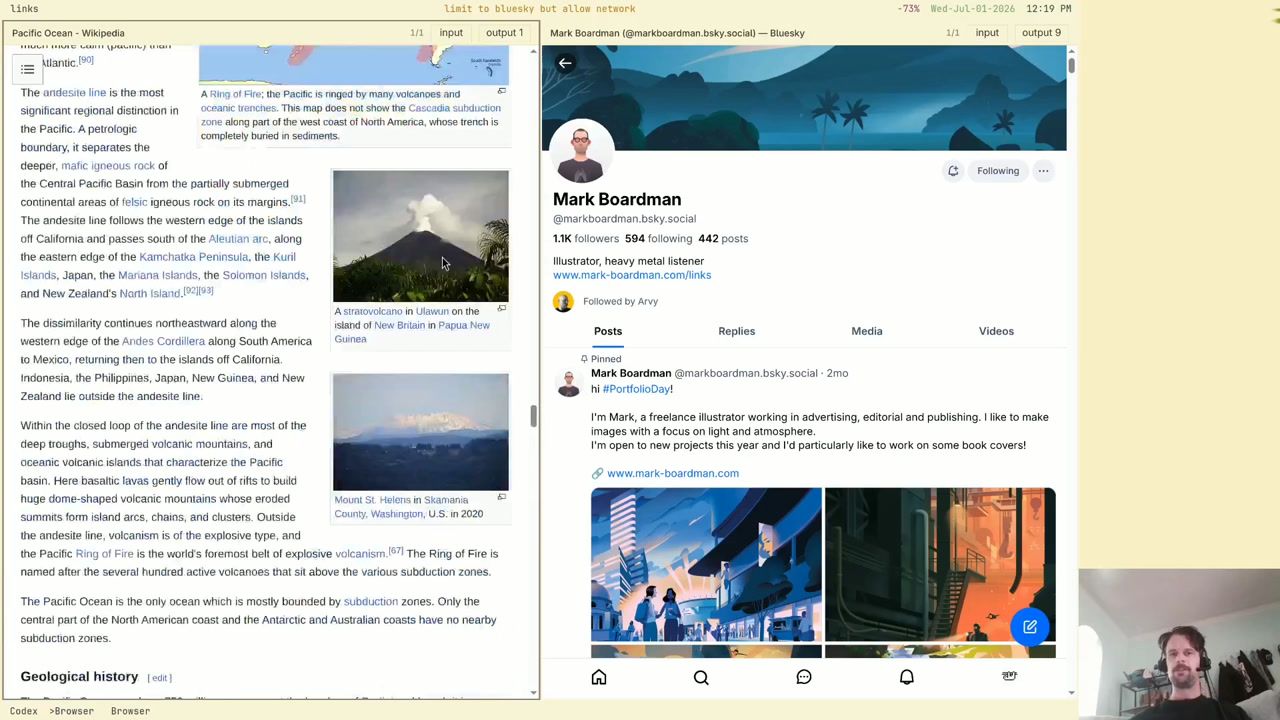
Experimenting with mini-browsers limited to specific urls or domains. Clicking on external links saves them to a list (that possibly you then feed into a different mini browser?). Recorded some thoughts on youtube.

Thinking about making a browser feel more like a place (thinking of Interface Studies' video). Also thinking of the satisfaction and clarity of plugging a cartridge/disk into a system.

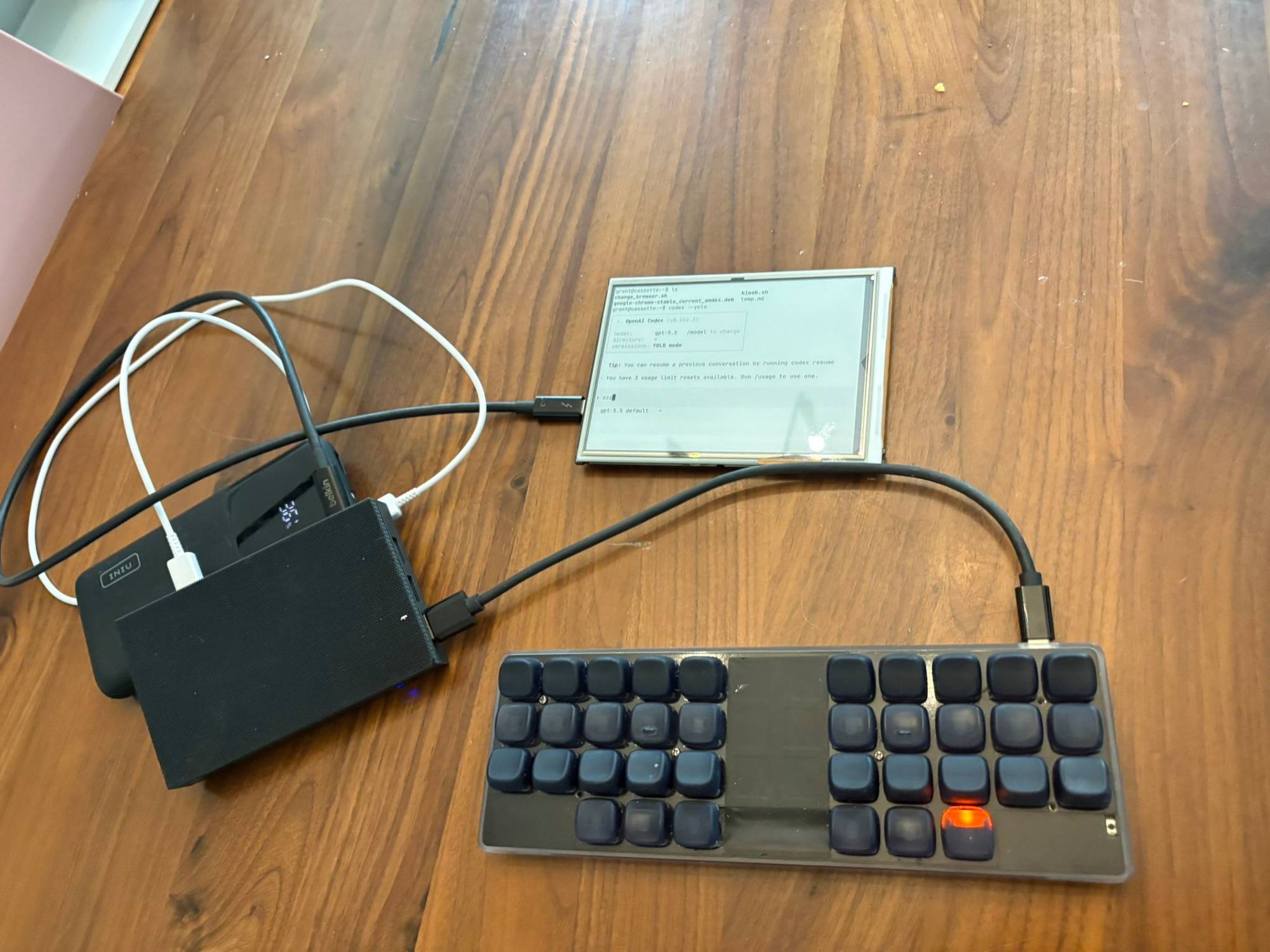
Writerdeck prototype

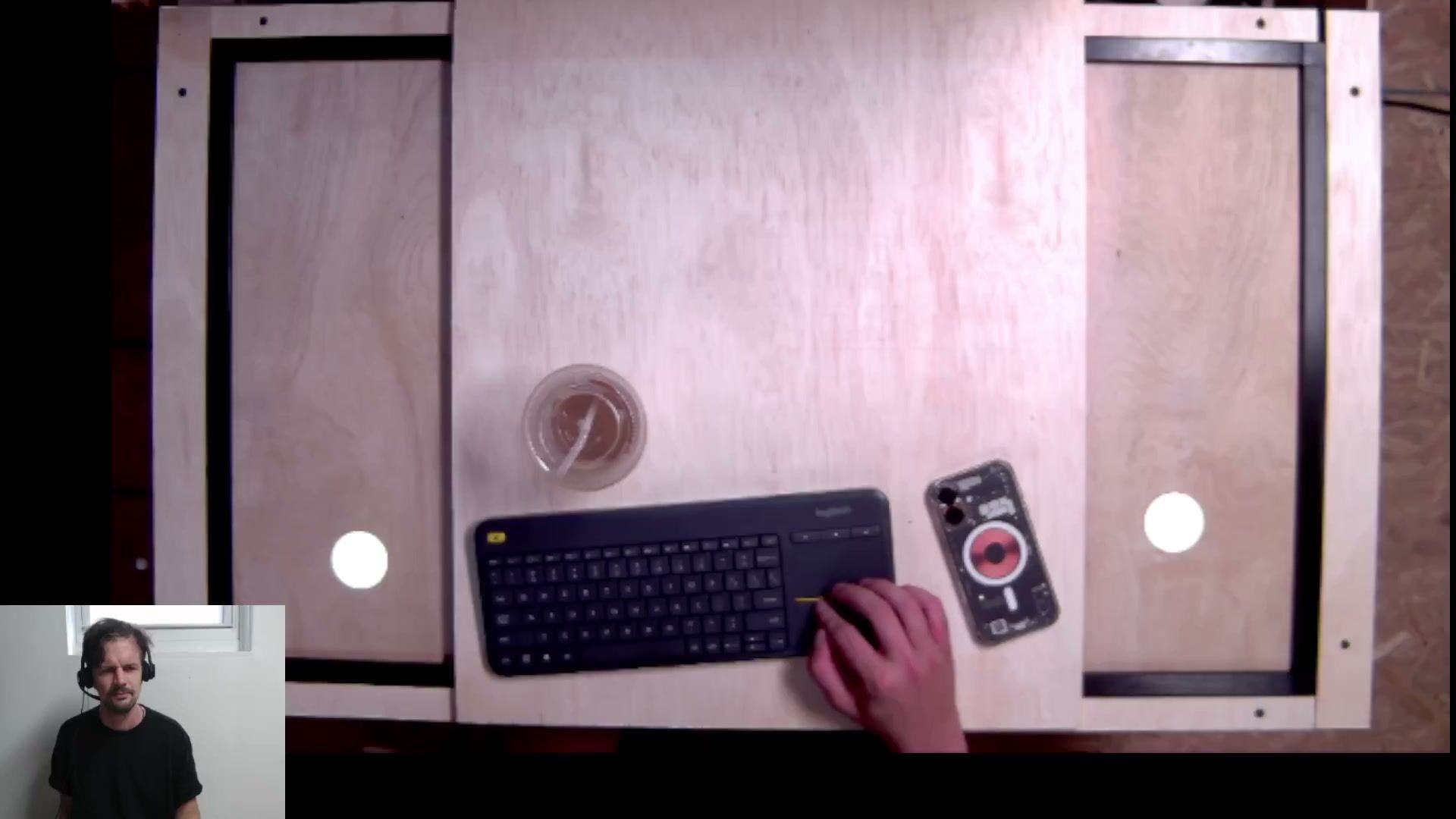
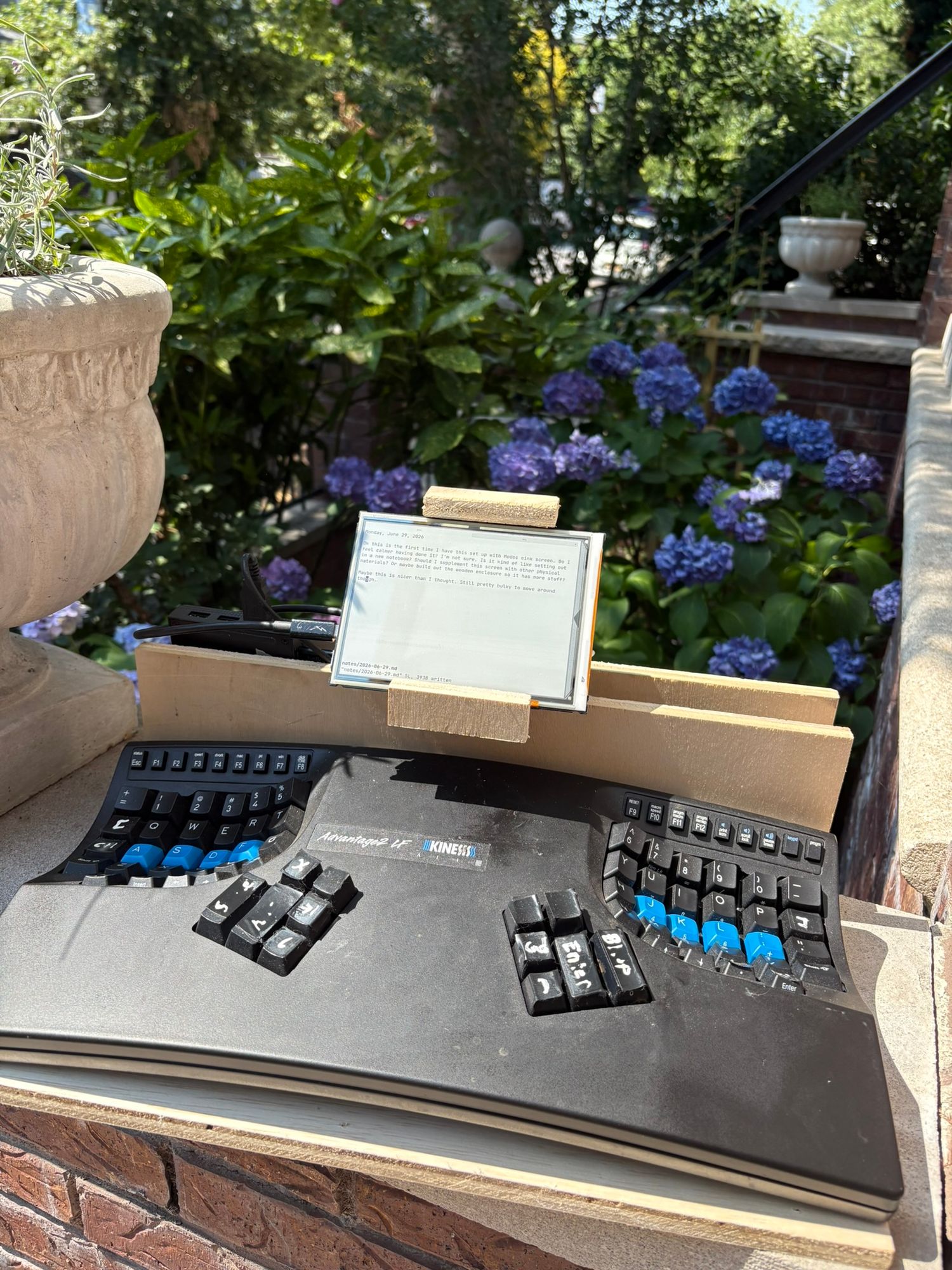
Put together a prototype writerdeck with the modos dev kit. Direct sunlight does work. It's a bit bulky and I should probably use one of my minimal low-profile keyboards, but I do love typing on the kinesis the most. In some other world I'd cut up and mod the kinesis body directly.

The currrent prototype.The currrent prototype.

The pieces laid out.The pieces laid out.

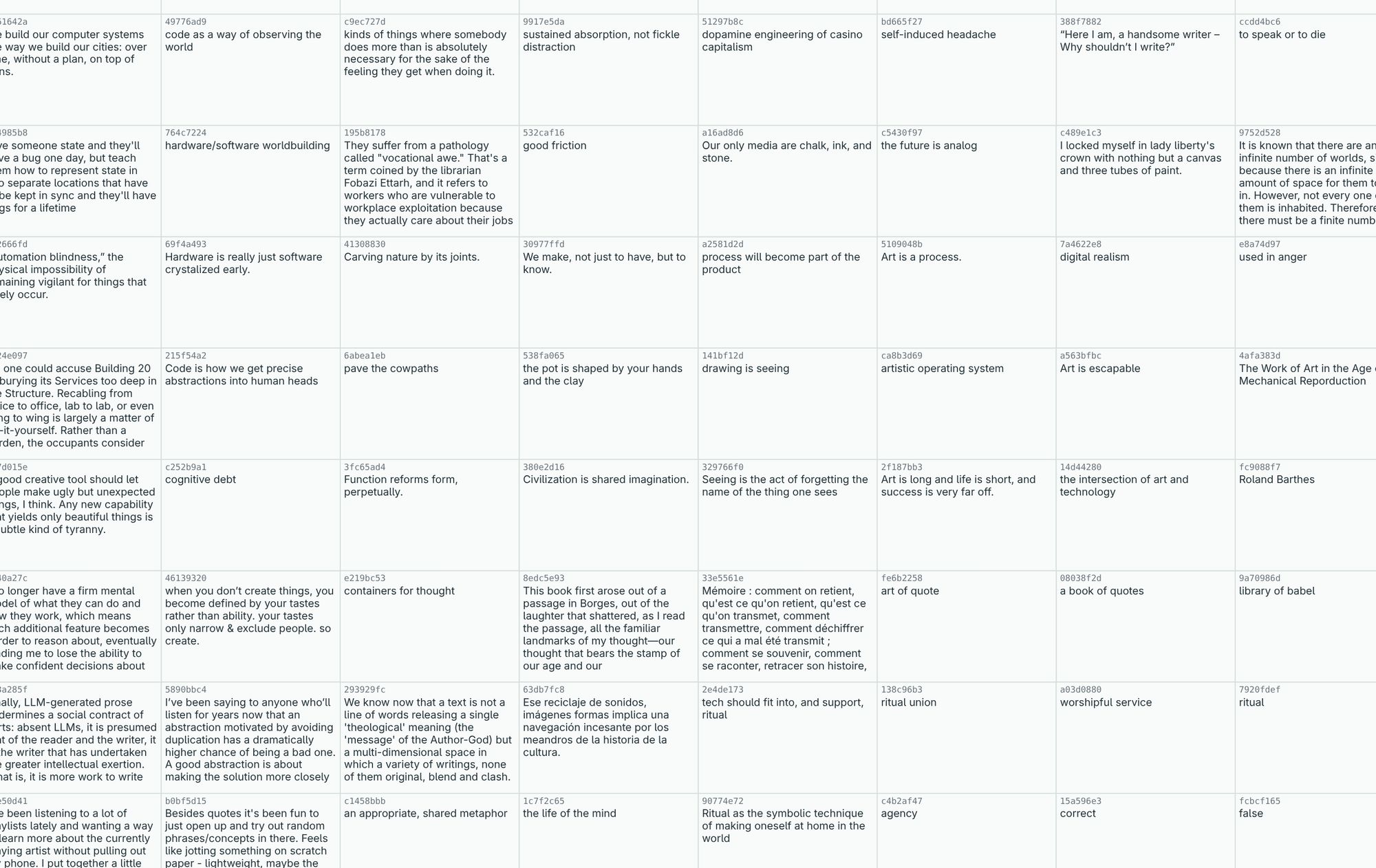
Cosine grid

Experimenting with putting the embedded texts from Cosine into UMAP and then fitting to a grid. Not as glanceable as images would be but I think there's probably some interesting moves to make here.

Topic continents

Wikimedia concepts embedded and then mapped to a sphere with UMAP. Trying out topic clusters as continents. Not sure where it's all going.

The Obelisk Gate

by N.K. Jemisinby N.K. Jemisin

I'm trying to spread out the series I read so it is a testament to how good The Fifth Season is that I jumped into this immediately.

The dedication is "For those who have no choice but to prepare their children for the battlefield" and you feel that all the way through the book. The relationship between Essun and Nassun is so well developed on both sides. Clear-eyed in the pain caused eac hother but also the reasons for it. It always feels like it is reporting, rather than pleading any one character's case.

Nassun's relationship to Schaffa and to her father also have these moments where the mechanisms of abusive relationships are revealed. And again Nassun's feelings within that feel reported, not judged, but also not elided. Which ends up feeling very compassionate towards her. If things were elided that would suggest they were things to be ashamed of. There's moments in the descriptions of the relationships where I thinkfeel (without having experienced anything like that myself) "oh of course that's how that would work".

I like the development of the stone-eater lore too. They feel like a wild card in what is already an interesting ecology of Orogenes and "stills". I feel like maybe the build-up to the suggestion of what Alabaster actually wants is drawn out a little, but I'm glad it is eventually just revealed.

Reader

Putting together a personal RSS reader that shows the original articles. With vim-style navigation.

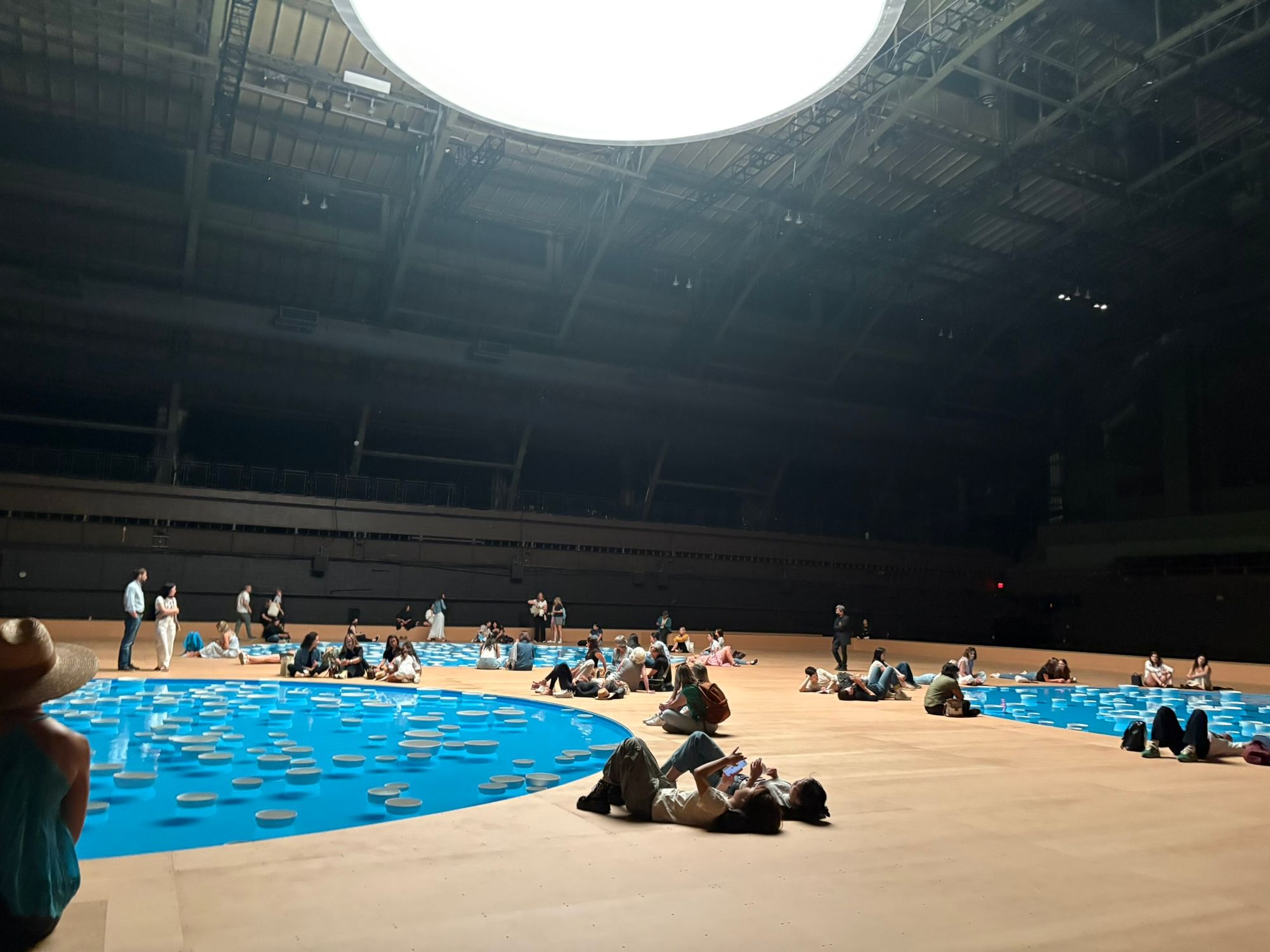
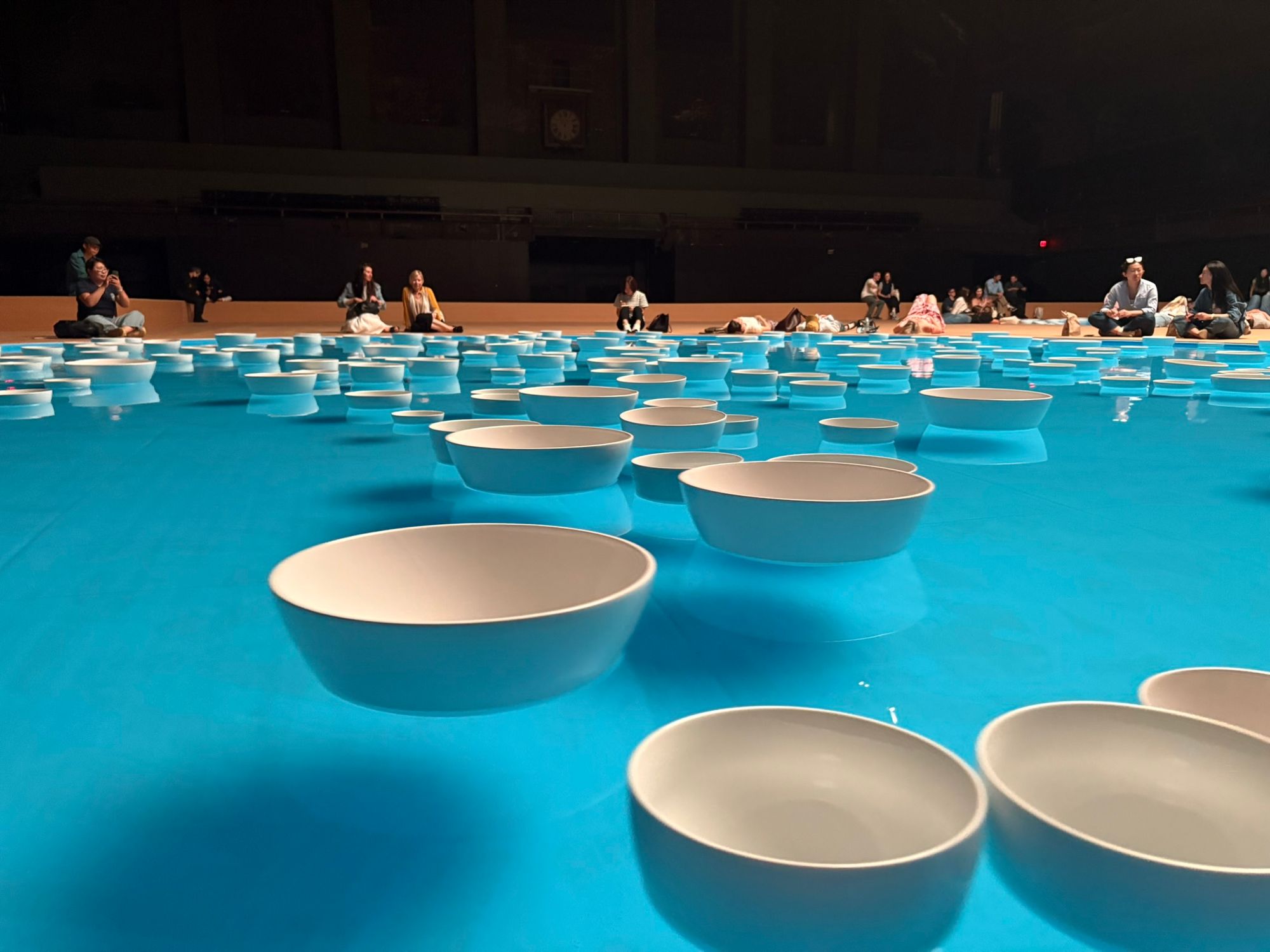
clinamen v.11 by Céleste Boursier-Mougenot

I saw the bowls (clinamen v.11 by Céleste Boursier-Mougenot). A perfect generative piece because you can immediately understand how it operates but the results are no less magical. It feels very like something from nature in that way.

It was nice to be around a bunch of other people who decided it was something worth making the effort to see.